
On this page
- Ultimate Recipient Report (URR)
- Section A – Introduction
- Section B – Summary
- Section C – Ultimate Recipient Details
- Section D – Definitions
Ultimate Recipient Report (URR)
The Ultimate Recipient Report (URR) collects standardized information on the clients that receive financial support from your organization as a direct result of your Contribution Agreement with the Federal Economic Development Agency for Northern Ontario (FedNor). This guidance document explains how to complete the URR as requested and outlines best practices for reporting the economic outcomes of funded projects.
As outlined in the performance measurement appendix of your Contribution Agreement, you are required to complete the attached Excel template entitled “Ultimate Recipient Report”. This template must be submitted with each financial claim and disbursement activity report submitted to FedNor throughout the duration of your agreement.
The URR is used to measure your organization’s performance under the Contribution Agreement and compiles the following information:
- Account and contact details for all entities receiving financial support, including whether leadership identifies with an equity-deserving group.
- The amount and timing of each financial disbursement provided to ultimate recipients.
- Project activities and economic outcomes achieved as a direct result of your organization’s financial support.
Reporting Requirements
To ensure consistent data aggregation across all intermediary organizations, the Ultimate Recipient Report (URR) template and its wording must not be modified. Submissions using altered templates will be returned for correction.
Important: The URR and its guidance materials were developed not just for your organization, but for all intermediary organizations under a Contribution Agreement with FedNor. As a result, certain project outcomes in the template may not apply to your specific deliverables. Only report on project outcomes relevant to your funded activities.
Submission Deadlines
Interim URR Submission: The due date is listed in the schedule included in your initial claims package. Contact your Program Delivery Officer if you require clarification.
Final URR Submission: Due within 90 days following the end date of your Contribution Agreement.
Reporting Period: Covers the start and end dates of financial claims and must be cumulative of all previous Ultimate Recipient Report (URR) submissions.
Completing the Ultimate Recipient Report (URR)
- Complete all sections of the URR for each funded project.
- Report every financial disbursement to an Ultimate Recipient as a separate line item, even when multiple disbursements are made to the same organization.
- Ensure each URR submission is cumulative.
- Do not create a new URR for each subsequent submission. Add new recipient information to the existing URR with each financial claim.
- Each URR must include all valid recipient information for the full duration of your agreement with FedNor.
- Highlight any updates or corrections to previously reported information in each submission, as required.
- Do not modify the URR template or its wording.
Submitting the Ultimate Recipient Report (URR)
- Submit each completed URR through the client portal to your assigned Program Delivery Officer by the due date specified in your claims schedule.
- Your Program Delivery Officer may contact you to clarify responses or request adjustments to ensure accuracy and consistency.
Section A – Introduction
Section A captures basic information about your organization and the project supported under your Contribution Agreement with FedNor.
Name of Client and and Project ID
Provide the name of your organization and the Project ID associated with your Contribution Agreement.
Reporting Period
Enter the Reporting Period Start Date as the start date of your most recent financial claim to FedNor, and the Reporting Period End Date as the end date of that claim.
After your first Ultimate Recipient Report (URR) submission, all subsequent URRs must be cumulative. This means that although the reporting period dates will change, each interim URR must include:
- All data previously reported, and
- All new data from the current reporting period.
This ensures proper data aggregation and allows you to revise previously reported information if needed.
Final URR Indicator
In the Final URR field, select "Yes" if the submission represents the final Ultimate Recipient Report (URR) for the project and no further funds will be redistributed to third-party organizations under your Contribution Agreement. Select "No" if additional disbursements will occur.
Privacy Notice
The Privacy Notice is provided solely for your awareness and acknowledgement. If you have any questions or concerns regarding this section, please contact your Program Delivery Officer.
Name of Client:
Sample Solutions
Reporting Period Start Date:
YYYY-MM-DD
Project ID:
123456
Reporting Period End Date:
YYYY-MM-DD
Final URR?
This form collects information on the clients that receive support from your organization as a direct result of your contribution agreement with the Federal Economic Development Agency for Northern Ontario (FedNor). It is important not to modify the template or wording used, so as to allow for data aggregation.
The form must be completed in full for each client that received financial assistance from your organization.
SECTION A - PRIVACY NOTICE
The information collected through this form will be used for statistical analysis, program evaluation, performance measurement, and reporting activities that support FedNor’s mandate for regional economic development and innovation. This information helps FedNor monitor program outcomes and impacts, inform the design and improvement of future programs, support audits and evaluations, and report to stakeholders, including Parliament and federal oversight bodies.
This data may also be shared with other federal institutions to allow indicators of firm level performance to be developed for analysis or for the purpose of program evaluation. Additionally, aggregated data may be included in public reports, after ensuring that confidential information on individual businesses cannot be identified in any of the data products that are developed for publication. Any disclosure will be consistent with applicable agreements and legal obligations.
All information provided will be protected under the provisions of the Access to Information Act and the Privacy Act. Under the Act, any person whose personal information is being directly collected by a federal government institution has the right to access, correction and protection of this information, as well as the right to file a complaint with the Privacy Commissioner of Canada. These laws provide individuals with rights related to personal information collected directly by a federal government institution. These rights include access to their personal information, the ability to request corrections to inaccurate or incomplete information, the expectation of appropriate protection of their data, and the ability to file a complaint with the Privacy Commissioner of Canada if they believe their rights have been violated.
The personal information collected is described in FedNor’s Personal Information Bank, listed in the Government of Canada’s Info Source repository. For more information, please visit the FedNor Info Source page.
Section B – Summary
Section B is fully pre-populated and automatically summarizes the project outcome data reported elsewhere in the Ultimate Recipient Report (URR). No input is required from your organization in this section.
This page is designed to help your organization cross-reference the outcomes reported in the URR with the results identified at key stages of your Contribution Agreement with FedNor, including:
- The assessment stage, when anticipated results were identified during the Contribution Agreement approval process;
- The ending stage, when final results are submitted, outlining all outcomes achieved as a direct result of your agreement with FedNor, and;
- The post-monitoring stage, when FedNor requests the Two-Year Follow-Up Report to capture any medium-term economic outcomes that occurred two years after the end date of your agreement.
Use this summary to support FedNor reporting exercises such as the Final Results process and the Two-Year Follow-Up Report.
| Definitions | |
|---|---|
| Project ID | 123456 |
| Organization Legal Name | Sample Solutions |
| Reporting Period Start Date | YYYY-MM-DD |
| Reporting Period End Date | YYYY-MM-DD |
| - | - |
| Ultimate Recipient Results | Decimal Value |
| Number of Ultimate Recipients receiving financial assistance from intermediary |
0
|
| Sum of studies or plans developed by Ultimate Recipients |
0
|
| Sum of new value added products, services, or processes developed by Ultimate Recipients |
0
|
| Sum of new value added products, services, or processes commercialized by Ultimate Recipients |
0
|
| Sum of new intellectual property assets filed by Ultimate Recipients |
0
|
| Sum of assets in support of innovation created, enhanced/adapted or acquired/adopted by Ultimate Recipients |
0
|
Section C – Ultimate Recipient Details
Section C captures detailed information about each third-party organization (Ultimate Recipient) receiving financial support from your organization as a direct result of your Contribution Agreement with FedNor. This page is divided into four sub-sections:
Account Details
This sub-section records the name, address, contact information, and CRA-issued Business Number of each Ultimate Recipient. All fields must be completed to the best of your ability.
- File Number: Provide a unique identifier for each Ultimate Recipient project. This identifier must remain consistent throughout the duration of your Contribution Agreement.
- Legal and Operating Names: Enter the legal name and, if applicable, the operating name of the Ultimate Recipient. If the business has not yet been created, you may enter the name of the entrepreneur receiving support.
- Business Number: Enter the 9‑digit CRA‑issued Business Number. This number is required for analytical and statistical purposes and must be the CRA Business Number—not a provincial registry number. Additional information is available at: https://www.canada.ca/en/revenue-agency/services/tax/businesses/topics/business-registration/business-number-program-account/need-bn.html
- Organization’s NAICS Code (2-Digit): Enter the primary 2-digit North American Industry Classification System (NAICS) that best describes your organization’s primary activity. For more details on NAICS, please review the following link: North American Industry Classification System (NAICS) Canada 2022 Version 1.0
- Contact and Organizational Information: Complete all fields capturing the Ultimate Recipient’s address, email, primary phone number, and other required details. Accurate contact information is essential, as recipients may be contacted for evaluation, audit, or statistical purposes.

Project Details
This sub-section captures information about the individual projects supported through financial disbursements to Ultimate Recipients. All fields in this section must be completed, as complete information is required for proper data aggregation.
- Project Description: Provide a brief description of the project and how the financial support will be used.
- Project Approval Date: Enter the date that your organization approved the project.
- Project Start and End Dates: Enter the dates that define the project’s duration.
- Disbursement Information: Complete all fields related to financial disbursements made under your Contribution Agreement. If the field asking whether a disbursement has been made is marked “No,” leave the subsequent disbursement‑related fields blank.

Important: Each financial disbursement must be reported as a separate line item. If an Ultimate Recipient receives multiple disbursements—whether as separate payments or partial installments—each disbursement must be recorded individually to ensure accurate data aggregation.
Project Outcomes
This sub-section outlines the economic outcomes expected to result from the Ultimate Recipient’s project activities funded under your Contribution Agreement. Some outcomes may not apply to your agreement.
- Economic Outcomes: Provide values only for outcomes that apply to the Ultimate Recipient’s project and are directly attributable to the funded activities. Nil responses are acceptable.
- Comments (Optional): Use the comments field to provide any clarifications or context related to expected project outcomes.

Important: Avoid double‑counting between related outcome fields. Definitions for each indicator are provided in Section D – Definitions.
Equity-Deserving Group Identification
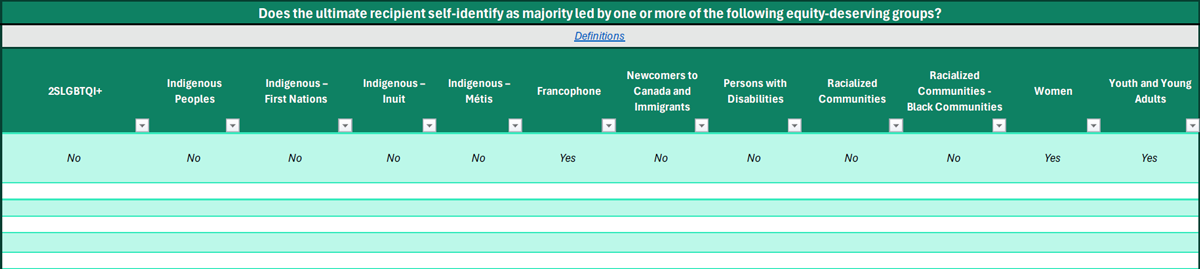
This sub‑section allows your organization to indicate whether the majority ownership or leadership (>50%) of an Ultimate Recipient self‑identifies as belonging to one or more equity‑deserving groups.
- Select “Yes” for each group that applies. Multiple selections may be made.
- If the Ultimate Recipient identifies as Indigenous, specify whether they are First Nations, Inuit, or Métis.
Section D – Definitions
This section provides definitions for all fields used throughout the Ultimate Recipient Report (URR). Refer to these definitions to ensure consistent and accurate reporting across all sections of the template.
If you have questions about any definition or require clarification on how to use the URR template, please contact your Program Delivery Officer.
| Section | Definitions |
|---|---|
| Summary | |
| Project ID | Unique identifier assigned to the project in the Contribution Agreement. |
| Organization Legal Name | Organization that has a signed Contribution Agreement with FedNor. |
| Reporting Period Start Date | Start date of the reporting period. For first-time reports, this is the project start date as outlined in the Contribution Agreement. For subsequent reports, this is the start of the current reporting period. |
| Reporting Period End Date | End date of the reporting period. If the project is ending, this date matches the project end date in the Contribution Agreement. |
| Ultimate Recipient | Organization that is receiving funding through an intermediary that has a signed Contribution Agreement with FedNor. |
| Ultimate Recipient Account Details | |
| File Number | Unique identifier assigned to each Ultimate Recipient project. This identifier remains unchanged throughout the duration of the Contribution Agreement. |
| Legal Name | Legal name of the Ultimate Recipient organization. |
| Operating Name | Operating name of the Ultimate Recipient organization. |
| Business Number | Unique 9-digit number assigned by the Canada Revenue Agency when an organization is established. |
| Organization's NAICS Code (2-Digit) | Two-digit North American Industry Classification System (NAICS) code that best describes the organization's primary activity. For more details, please review the list of NAICS here: https://www23.statcan.gc.ca/imdb/p3VD.pl?Function=getVD&TVD=1369825 |
| Street Address | Street address of the Ultimate Recipient’s location. |
| City | City where the Ultimate Recipient is located. |
| Province | Province where the Ultimate Recipient is located, or country if outside Canada. |
| Postal Code | Postal code of the Ultimate Recipient’s location. |
| Phone Number | Primary phone number of the Ultimate Recipient. |
| Email Address | Email address of the Ultimate Recipient. |
| URL | Primary website of the Ultimate Recipient. |
| Ultimate Recipient Project Details | |
| Project Description | Short description of the Ultimate Recipient’s project, outlining its purpose or focus. |
| Project Approval Date | Date the project was approved. |
| Project Start Date | Date the project started. |
| Project End Date | Date the project ended. |
| Total Project Costs | Total actual costs for all project activities occurring between the project’s start and end dates. |
| Requested Amount | Amount of financial support requested by the Ultimate Recipient in the application. |
| Financial Disbursement Value | Portion of actual project costs covered by the intermediary using the contribution received from FedNor. |
| Contribution Disbursement Date | Date the Ultimate Recipient received a financial disbursement from the intermediary. This date must fall within the reporting period. |
| Project Outcomes | |
| Studies or plans developed | Documents developed through systematic investigation to support planning or decision-making. Examples include strategic plans, feasibility studies, business plans, market studies, and sector analyses. |
| Value-added products, services, or processes developed | New or improved products, services, processes, or technologies developed to increase financial value. Examples include enhancements in specifications, materials, usability, techniques, equipment, or software. |
| Value-added products, services, or processes commercialized | New or improved products, services, processes, or technologies developed to increase financial value. Examples include enhancements in specifications, materials, usability, techniques, equipment, or software. |
| Intellectual property created or licensed | Intellectual property created or licensed as a direct result of the project. Includes copyrights, patents, trademarks, and licences. |
| Assets in support of innovation created, acquired/adopted or enhanced/adapted | Technology, physical assets, or knowledge-based capital that support innovation. Includes equipment, facility upgrades, ICT infrastructure, intellectual property, and competencies created, acquired, or improved through project activities. |
| Equity-Deserving Groups | |
| Organization led or majority led by one or more of the equity-deserving groups | Organization in which individuals from equity-deserving groups either: A. Own more than 50% of equity or voting shares; OR B. Hold long-term control and influence through capital investment and active leadership in strategic and operational decisions. |
| 2SLGBTQI+ | Acronym referring to individuals who identify as Two-Spirit, lesbian, gay, bisexual, transgender, queer, intersex, or with other gender or sexual diversity terms. |
| Francophone | Individuals who identify as Francophones, the Official Language Minority in Northern Ontario. |
| Indigenous Peoples | Individuals who identify with the Indigenous Peoples of Canada, including First Nations, Métis, and Inuit, as well as those registered under the Indian Act or affiliated with a First Nation or Indian band. |
| Indigenous Peoples – First Nations | Individuals who identify as First Nations, with or without additional Métis or Inuit identity. |
| Indigenous Peoples – Inuit | Individuals who identify as Inuit, with or without additional Métis or First Nations identity. |
| Indigenous Peoples – Métis | Individuals who identify as Métis, with or without additional Inuit or First Nations identity. |
| Newcomers to Canada and Immigrants | Individuals who identify as newcomers to Canada or as immigrants. Newcomers are landed immigrants who arrived within the past five years. Immigrants include those who have been granted permanent resident status, with or without Canadian citizenship. |
| Persons with Disabilities | Individuals with physical, mental, intellectual, cognitive, learning, communication, or sensory impairments, or functional limitations—whether permanent, temporary, episodic, visible, or invisible—that interact with barriers to hinder full and equal participation in society. |
| Racialized Communities | Individuals, excluding Indigenous Peoples, who identify as non-Caucasian in race or non-white in colour (e.g., South Asian, Chinese, Filipino, Latin American, Arab, Southeast Asian, West Asian, Korean, Japanese). For FedNor’s purposes, Black communities are identified separately. |
| Racialized Communities – Black Communities | Individuals who identify as members of the Black community. |
| Women | Individuals who identify with the female gender, including cisgender and transgender women. |
| Youth and Young Adults | Individuals between the ages of 15 and 29 who identify as youth or young adults. |