
On this page:
- Purpose
- Northern Ontario context
- Creating the strategy
- Supporting innovation
- Growing companies
- Stronger communities
- Looking ahead
Purpose
- This Report measures how the Prosperity and Growth Strategy for Northern Ontario (PGSNO) has worked to meet its intended goals and outcomes since its launch in 2018.
- Given that the economic landscape of Northern Ontario has shifted over the last five years, this report highlights the new economic realities facing the region's communities.
- The report examines federal efforts and year-over-year changes across the Northern Ontario economy to demonstrate where progress has been made and where more efforts are needed.
- The report will serve as the foundation for building a refreshed set of PGSNO priorities and outcomes with stakeholders by 2025.
Northern Ontario context
Five years since the launch of the PGSNO , Northern Ontario's economy is characterized by the development of new sectors with better job opportunities and more diverse communities.

| Total GDP (2020) | $35.02 billion [Footnote i] |
|---|---|
| Population (2020) |
856,193 or 6.0% of ON population[Footnote ii] |
| Largest Cities (2020) |
Greater Sudbury Census Metropolitan Area (170,605) |
| Indigenous (2020) |
140,310 or 16.7% of Northern Ontario's population or 34.5% of Ontario's Indigenous population [Footnote iii] |
| Francophone (2020) |
108,795 or 12.9% of Northern Ontario's population or 23.5% of Ontario's Francophone population[Footnote iv] |
| Number of Communities |
150 municipalities; 31 official language minority communities; 105 First Nation communities; 31 remote communities |
Ongoing regional challenges
- Aging and inadequate infrastructure
- Reliance on single industries
- Labour market challenges
- Low exports and technology adoption
- Slow business growth
Regional opportunities
- Sectoral growth and emerging industries
- Strong innovation ecosystem
- Diversifying workforce
Creating the strategy
At its core, the strategy is intended to build on the ongoing federal programs and collaborations to address the needs of Northern Ontario's communities and its residents.
- In 2017, FedNor was asked to lead the development of a regional growth strategy that would address the specific needs and issues important to local residents, communities and businesses.
- Over 1,000 stakeholders across the region, the private sector, industry, communities and First Nations, post-secondary institutions, innovation centres, and others helped to inform priorities and action areas and outcomes.
- In 2018, the strategy was officially launched.
Areas of collaborative action
Supporting innovation by expanding and strengthening the regional innovation ecosystem and providing support for incubators, accelerators and clusters;
Growing companies by enhancing supports for business start-ups and scale-ups, promoting the adoption of advanced technologies, and increasing the capacity of companies to export; and,
Building stronger communities by helping municipalities and Indigenous communities better respond to economic development opportunities and challenges.
Goals and intended outcomes
- Increase regional exports
- More businesses develop and adopt technologies
- New opportunities for Indigenous Peoples and enterprises
- Further opportunities for women entrepreneurs
- Add professional, science and tech-related jobs
- Increase skilled and trade workers
- Strengthened communities, better equipped to respond to opportunities
- A stronger innovation ecosystem that will accelerate business growth
Supporting innovation
The Government of Canada has worked with key players to encourage businesses and communities to enhance innovation, productivity, and competitiveness through technology adoption, commercialization, and research. As a result of these efforts, the innovation ecosystem in Northern Ontario is stronger, with greater visibility, growing priority sectors, and new technology.
Government Efforts
- Coordination across various levels of government, industry leaders, universities and Indigenous partners to seize new growth opportunities and spur innovation
- $170 million dedicated to regional innovation ecosystem projects, including $60 million provided by FedNor, creating 580 innovation assets
- $420 million invested by Innovation, Science and Economic Development Canada and Infrastructure Bank of Canada to support the clean technology Algoma Steel Electric Arc Furnace transformation
- $315 million total Strategic Innovation Fund investments in Northern Ontario from 2019 to 2021
- New linkages and pathfinding across priority and emerging sectors, including digital, health sciences and biomedicine
- Growing intellectual property ownership through the National Intellectual Property Strategy
Evidence shows the fastest way for businesses to boost productivity and growth is to innovate. Innovation drives economic progress and ultimately benefits the larger regional economy.
Regional Innovation Centres
With funding from the federal government, regional innovation centres have helped Northern Ontario's entrepreneurs and innovators succeed in international markets, overcome challenges of developing their ideas and make them marketable.
- Priority Sector Growth: The Government of Canada has promoted the expansion of existing priority and emerging sectors including forestry, mining, manufacturing, tourism, health and life sciences, and agri-food in Northern Ontario. These sectors continue to grow at a greater rate than the national average and are key areas of innovation for the region.
The Strategic Innovation Fund has committed a total of $40 million in funding towards the Mining Innovation Commercialization Accelerator Network through the Centre for Excellence. This network connects Canada's regional mining clusters and brings together companies, suppliers, academic and research institutions, innovators.
- Assets, Commercialization and Intellectual Property: Since 2018, the National Intellectual Property Strategy has directed supports to Canadian businesses seeking opportunities to grow intellectual property ownership. In Northern Ontario, FedNor has helped business and organizations create 95 new intellectual properties (such as patents, copyrights, trademarks), 1,140 value-added commercialized assets, and develop 1,726 value-added processes, products, and technologies.
- Regional innovation clusters: The continuous growth and success of large industry-specific networking events like the annual Prospectors and Developers Association of Canada convention demonstrates the regions' ability to attract world-wide interest and grow stakeholder partnerships.
- Key players in the innovation ecosystem network include:
- Regional innovation centres
- Post-secondary institutions
- Business accelerators and incubation hubs
Outcomes
- A stronger regional innovation ecosystem. With new local incubators and accelerators, a stronger network of options has positioned entrepreneurs to pursue innovation
- Growth in priority sectors. The rate of employment in priority sectors within Northern Ontario is 28% above the national average. Moreover, from 2016-2023, the rate of employment grew by 10.8% (compared to 9.6% nationally)
- More professional, science and tech-related jobs with a 19% increase in the number of people employed within the sector from 2018 to 2023
Growing companies
Since 2018, the Government of Canada has helped businesses maximize potential, reach new markets, and ensure entrepreneurs from equity-deserving groups have an equal footing in the marketplace. Evidence shows the number of businesses is increasing in the region and the majority continue to report growth.
Government Efforts
- $690 million invested towards business scale-up and productivity projects, including $294 million from FedNor, to support 5,554 businesses.
- Delivery of sector-specific supports to strengthen regional interests like the Targeted Steel and Aluminum Initiative
- Helping companies maximize growth through the Accelerated Growth Service, onboarding 12 clients from Northern Ontario (4 more than 2019)
- Supporting Community Futures Development Corporations to address the localized needs of businesses
- Creating opportunities for equity-deserving groups through programs like Women's Entrepreneurship Strategy and the Black Entrepreneurship Program
Small and medium-sized enterprises are the foundation of the Canadian economy and key drivers of regional growth. As of June 2023, Northern Ontario is home to over 72,000 businesses, nearly all of which are small or medium-sized enterprises.
- Community Futures: Supporting a stronger Community Futures Development Corporation network has been an important focus for regional development. The average survival rate for businesses accessing support from a Community Futures Development Corporation in Northern Ontario is nearly 96% (7% higher than non-clients).
- COVID-19: The Canadian Government helped businesses mitigate the negative economic impacts of the COVID-19 pandemic. Most businesses applied for the Canada Emergency Business Account (88%) and the Canada Emergency Wage Subsidy (63%). In Northern Ontario, 5% of small and medium-sized enterprises (SMEs) applied for the Regional Relief and Recovery Fund (a higher proportion than Ontario and Canada). This fund allocated $71.8 million to Northern Ontario businesses, aiding in employee retention and cost coverage. The Jobs and Growth Fund was launched to stimulate economic recovery by investing projects to future proof communities and transition to the green economy. Since 2021, $27 million in federal investments was delivered through FedNor.
- The region's tourism industry, severely impacted by border closures, received over $25 million from the Tourism Relief Fund from 2021-2023. Additionally, the government supported the air and transport industries, contributing $11.6 million to the aerospace sector's recovery.
Outcomes
- Value of Northern Ontario exports increased by 45% from 2021-22 to $11 billion. In 2020, twice as many businesses reported looking to expand sales into new markets over the next three years (vs 2017)
- More high growth firms in the region; twice as many since 2016. However, more businesses reporting no growth (6.3% increase)
- Businesses are adapting new technologies. More businesses have gone digital (a 25.9% increase in websites from 2017 to 2020)
- More businesses are owned by visible minorities, youth and those with a disability. However, there's a decline in the proportion of Indigenous-owned SMEs (by 3%), as well as SMEs owned by women (by 2%) and Francophone individuals (by 2%)
- More skilled and trades workers in the region to help close the skilled labour gap; 13.5% increase in the number of people employed within the trades sector from 2017 to 2020
Number of businesses in Northern Ontario
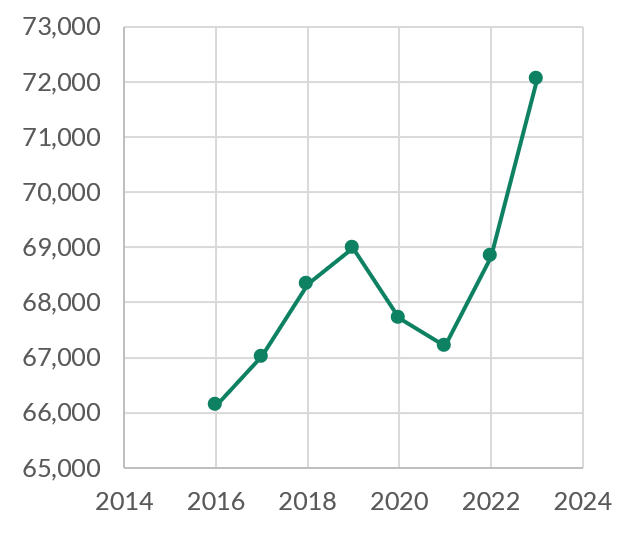
Text version
| Year | Total number of Businesses |
|---|---|
| 2016 | 66,125 |
| 2017 | 67,025 |
| 2018 | 68,337 |
| 2019 | 68,983 |
| 2020 | 67,710 |
| 2021 | 67,205 |
| 2022 | 68,831 |
| 2023 | 72,042 |
- Positive Growth: 63% of Northern Ontario small and medium-sized enterprises reported positive average yearly growth in sales or revenues between 2017 and 2020. Simultaneously, fewer businesses report obtaining financing as major obstacle to business growth (from 8.8% in 2017, down to merely 4.8% in 2021).
Stronger communities
Since 2018, the Government of Canada has made strategic investments to help build community capacity, increase economic competitiveness, and foster collaboration and growth. While challenges around out-migration and aging infrastructure remain, communities are more diverse and are better equipped to respond to opportunities.
Just over half of the population of Northern Ontario resides in the region's five urban centres while the remainder live in small and dispersed communities across the region (more than 80% have a population of less than 2,000).
Government efforts
- $436 million invested in the region to community economic development projects; 307 physical community assets developed/modernized/expanded
- Universal Broadband Fund provided broadband connectivity to 239 communities in Northern Ontario
- $35.8 million invested by FedNor to projects towards projects that primarily benefit youth; $11.7 million towards projects that benefit Francophone communities
- Commitments to advancing economic reconciliation and support Indigenous-led economic development
- New initiatives to attract and retain skilled immigrants in rural and Northern communities and spread the benefits of economic immigration
- Indigenous community capacity development: Community capacity development remains a challenge for many First Nations and rural remote communities in the region. The Community Investment Initiative for Northern Ontario delivered by FedNor complements existing funding provided through other federal programming. Since 2018, nearly $113 million has been dedicated towards First Nation and community-owned projects in the region.
- Progress on Infrastructure: Infrastructure Canada supported projects across Northern Ontario through various programs and initiatives including the Active Transportation Fund, the Clean Water and Wastewater Fund, the Public Transit Infrastructure Fund and the Investing in Canada Infrastructure Program.
Canada is on track to achieve the goal of connecting 100% of Canadians to highspeed Internet by 2030. However, much of the gap remains in Northern Ontario. Of the 285 communities in the region, just 74 communities have at least 50% of their households able to access 50/10 Mbps as of 2023.
- Diversifying communities: The Rural and Northern Immigration Pilot, launched in 2019, has diversified smaller communities by providing residency to skilled foreign workers, creating 3,527 jobs. Northern Ontario has also become a region of choice for international students. With significantly higher tuition rates, international students positively contribute not only to post-secondary institution operations, but to the surrounding local economy.
- Opportunities for youth: The Youth Internship Initiative delivered by FedNor further supports this by providing valuable work experience.
- Supporting Francophone communities: Northern Ontario needs 12,391 French-speaking immigrants annually for a decade to maintain its population. Despite a decrease from 13.9% in 2017 to 11.4% in 2020, the region still has a higher percentage of Francophone-owned businesses compared to the rest of the province. Programs such as the Welcoming Francophone Communities Initiative and Canada's Economic Development Initiative support language retention and enable official minority language communities to leverage linguistic duality for economic opportunities
Outcomes
- Twice as many International students in Northern Ontario post-secondary schools (2021 vs 2018). 1690 newcomers welcomed through the Rural and Northern Immigration Pilot (RNIP) as of 2023
- Greater employment opportunities for youth; with the majority of youth interns indicating they have secured employment in Northern Ontario
- More skilled workers and sector diversity; with more jobs in management, business finance and administration, health, and natural and applied sciences
- Welcoming Francophone Communities Initiative: Sudbury participated in the Welcoming Francophone Communities Initiative putting a spotlight on the services available to French-speaking newcomers. The introduction of more services that permit newcomers to more easily build a sense of belonging in their community can help tackle some of the greatest challenges faced by those arriving in Northern Ontario.
Looking ahead
Looking ahead over the next year, a PGSNO renewal exercise will build upon the opportunities highlighted in this report and offer further refinement to the strategies priorities. Several key themes for further engagement have emerged including:
- Sustainable development and growing the green economy
- Infrastructure; transportation and housing economies
- Strengthening labour forces through immigration, talent attraction, retention, and up-skilling
- Growing access to capital opportunities for equity-deserving groups including youth, women, Francophones, Indigenous Peoples and visible minorities
- Improving targeted supports for Northern Ontario's priority sectors
- Advancing economic reconciliation and supporting Indigenous-led economic development
PGSNO Roadmap to Refresh
Spring
- Finalize Progress Report and engagement planning
Summer
- Host targeted engagement sessions to collect feedback on new areas of focus
Fall
- Incorporate feedback to develop a refocused Strategy for the region